Asaan POS: A Retail Operating System Built for Growing Stores
Asaan POS
SaaS Product Architecture and Development
2026
Software Engineering
Project Overview
Retail businesses often outgrow basic point-of-sale software long before they are ready for a costly enterprise system.
Asaan POS was designed to fill that gap.
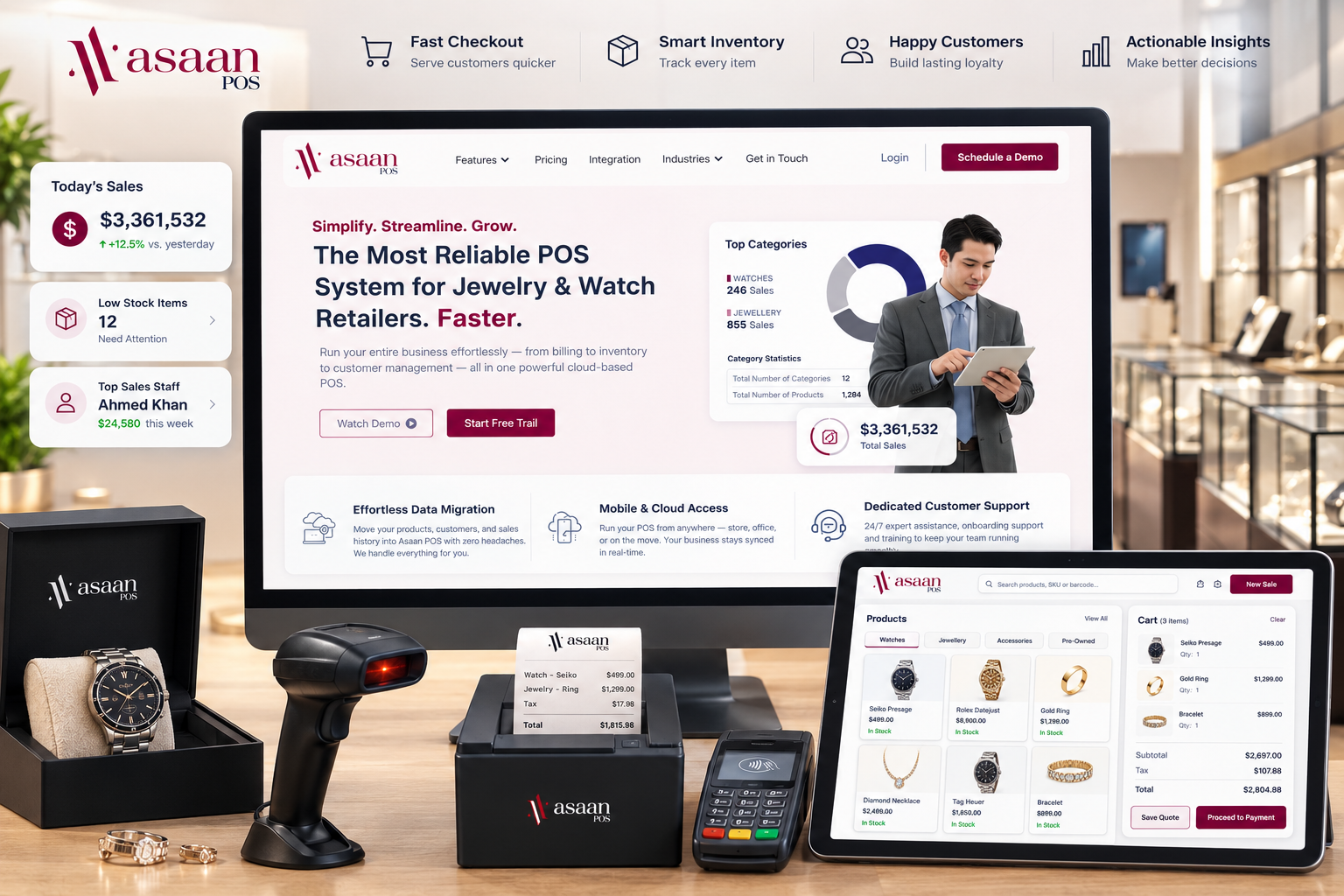
The platform brings sales, inventory, customer management, staff activity and store operations into one connected system. It is built for retailers that need more control than a simple checkout terminal can provide, without forcing every team member to work through complicated enterprise software.
From ringing up a sale to tracking serialized inventory, processing returns, managing layaway orders and reviewing performance across locations, the system keeps the full retail operation connected.
The challenge
A modern POS does far more than accept payments.
It must keep stock accurate across stores and warehouses, handle different transaction types, protect customer and payment data, support staff permissions and produce reports owners can actually use.
The platform also needed to accommodate operational cases that standard ecommerce systems often struggle with:
- Serialized and high-value products
- New and pre-owned inventory
- Layaway and partial payments
- Returns, exchanges and store credit
- Staff commissions
- Gift cards and gift receipts
- Multi-location stock movement
- Cash drawer reconciliation
- Customer loyalty and registries
The challenge was to bring these workflows together without making checkout slower or harder for store staff.
What we built
Fast retail checkout
The sales interface was designed for everyday store use, with product search, barcode support, customer lookup, discounts, taxes and flexible payment handling.
Staff can complete common transactions quickly while still having access to more advanced options when needed.
Serialized inventory management
Individual items can be tracked using serial numbers, making the platform suitable for watches, jewellery, electronics and other high-value products.
Each unit can retain its own purchase, sale, return and movement history.
New and pre-owned stock
Pre-owned products are managed separately from standard inventory, allowing retailers to record condition, acquisition details, individual cost and resale value.
Layaway and partial payments
Customers can reserve products and pay over time. Staff can record deposits, monitor balances and complete the sale once the required amount has been received.
Returns, exchanges and store credit
The returns workflow supports refunds, exchanges and store-credit issuance while keeping inventory and transaction records synchronized.
Customer profiles and loyalty
Customer records bring together contact details, purchase history, loyalty activity, store credit and preferences.
This gives retail teams a clearer picture of the customer during and after the sale.
Employee roles and commissions
Role-based permissions control what cashiers, managers and administrators can access.
Commission rules can also be connected to sales activity so staff performance is tracked without relying on separate spreadsheets.
Warehouse and store inventory
Stock can be managed across warehouses and retail locations, with transfers, adjustments and availability tracked through one system.
Reporting and reconciliation
Managers can review sales, margins, inventory, returns, staff performance and cash activity.
End-of-day cash reconciliation helps stores identify differences between recorded transactions and the physical drawer balance.
Ecommerce and business integrations
The platform architecture supports connections with Shopify, NetSuite, payment providers and retail hardware.
These integrations allow product, order, customer and inventory data to move between systems instead of being entered repeatedly.
Technical approach
Asaan POS was architected using a React and Next.js interface supported by Laravel-based backend services.
MySQL manages structured operational data, while MongoDB supports flexible records and high-volume activity where appropriate. AWS infrastructure provides the foundation for storage, processing, backups and future scaling.
The application was designed around modular services so inventory, customers, payments, reporting and integrations can evolve without requiring the entire platform to be rebuilt.
Security and reliability
Because the system handles sensitive retail and payment activity, security was planned into the architecture from the beginning.
The platform includes role-based access, audit histories, two-factor authentication, encrypted communication and controls aligned with PCI-DSS requirements.
Important actions—such as refunds, inventory adjustments and permission changes—can be recorded so management has a traceable operational history.
The difficult part of the build
The hardest part of a retail platform is not the checkout screen. It is keeping every action consistent behind it.
A return must update the payment record, customer history, inventory quantity, serial-number status, commission report and financial totals. A stock transfer must remain visible at both the sending and receiving location. A layaway order must reserve the correct unit without treating it as a completed sale.
Asaan POS was designed around these connected workflows rather than treating each feature as an isolated module.
Outcome
Asaan POS gives retailers one system for managing the activity that happens at the counter and the operations happening behind it.
Store teams gain a faster, more structured way to work. Managers gain clearer control over stock, staff and transactions. Business owners gain reporting that reflects what is actually happening across their locations.
The result is a retail platform that can begin with a single store and grow into a wider multi-location operation without changing the core system.
More Projects