Statty AI: Turning Shopify Data Into Clear Business Decisions
Own Product
Software Engineering, E-Commerce Optimization
2026
SasS
Project Overview
Most Shopify merchants do not have a shortage of data. They have too many reports, too many tabs and too little time to work out what actually deserves their attention.
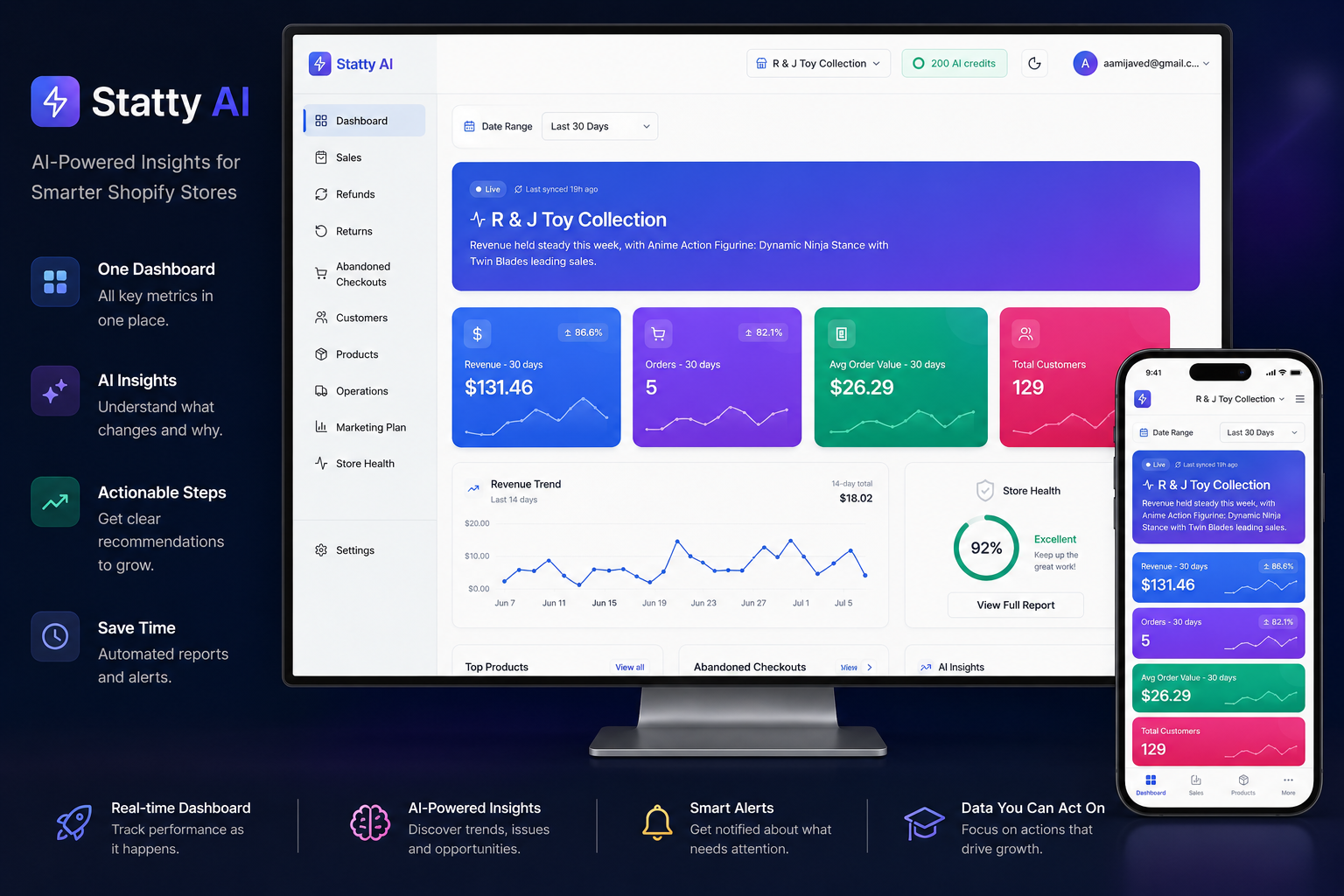
Statty AI was created as a practical command centre for store owners. It brings sales, customers, products, refunds, abandoned checkouts, inventory and store-health information into one visual dashboard, then adds plain-language analysis to help merchants understand what is changing inside their business.
Instead of expecting owners to interpret disconnected charts, the platform is designed around a simpler question:
What is happening in the store, and what should the owner look at next?
The live Shopify app provides revenue and order analysis, customer reporting, product performance, refunds and returns, abandoned-checkout monitoring, inventory alerts, SEO health checks and AI-assisted reports.
The challenge
Shopify already gives merchants access to a large amount of reporting. The problem is that the information is spread across different screens and often requires manual comparison.
A store owner may notice that revenue has dropped without immediately seeing whether the cause is lower traffic, weaker conversion, an increase in refunds, declining repeat purchases or stock running out on a leading product.
Statty AI brings these signals together in one place so owners can move from reviewing reports to making decisions.
What we built
A single store-performance view
The dashboard gives owners a quick picture of revenue, orders, products, customers and operational activity without requiring them to assemble reports manually.
Customer intelligence
Merchants can review total, active, new, returning and at-risk customers. Customers can also be grouped into practical segments such as VIP, loyal, new and at-risk, with revenue contribution shown for each segment.
Sales and product analytics
The platform highlights sales movement, order behaviour, product performance and historical trends, giving owners a clearer view of what is selling and where momentum may be changing.
Inventory visibility
Low-stock and out-of-stock alerts help merchants identify products that may require attention before availability begins affecting sales.
Refund and return reporting
Refund activity is separated from headline sales figures, making it easier to see where returns may be affecting actual store performance.
Abandoned-checkout monitoring
The dashboard compares completed and abandoned checkout activity, helping merchants understand how much buying intent is being lost before purchase.
Store health and SEO audits
Statty AI also examines broader store-health and SEO indicators so merchants can review commercial performance and technical visibility from the same platform.
AI-assisted insights and reporting
Merchants can generate summaries, ask questions about their store data and create reports without manually interpreting every chart. The purpose is not to replace the owner’s judgement, but to reduce the time spent finding the information behind a decision.
Product vision
The larger product roadmap takes the dashboard beyond reporting and toward prioritised operational guidance.
The planned CEO Screen introduces red-flag detection, a weekly focus recommendation, product funnel drop-off analysis, inventory risk estimates, profit visibility and a prescriptive action queue. Rather than presenting every issue with equal importance, the system is designed to rank problems using impact, confidence and urgency.
That roadmap also includes concise daily CEO briefs, alert delivery through email or Slack, and optional acquisition, retention and fulfilment panels.
Technical approach
The platform was planned as an embedded Shopify application with a Next.js and TypeScript interface, Shopify Polaris components and a Laravel-based backend.
Shopify OAuth provides secure installation and authentication, while webhooks and scheduled data jobs support the collection of order, product, customer, inventory and fulfilment information. PostgreSQL and Redis support reporting, background processing and scalable data ingestion.
The architecture also accounts for token encryption, webhook verification, role-based access, audit logging and merchant-data deletion requirements.
Outcome
Statty AI gives Shopify owners a cleaner way to understand the commercial health of their store.
Instead of jumping between customer reports, product screens, abandoned checkouts, inventory pages and spreadsheets, merchants can review the business from one dashboard and focus more quickly on the areas that require action.
The product is live on the Shopify App Store with three subscription levels covering core analytics, deeper historical reporting, fulfilment analysis and expanded AI-assisted reporting.
More Projects
Try It On: Bringing the In-Store Watch Experience Online
Shopify Development - 2026