FruitCo: Engineering a Smarter Online Grocery Experience
FruitCo Australia
Custom Feature Development, Managed Operations & Business Process Outsourcing
2024
E-commerce
Project Overview
Selling groceries online is considerably more complicated than building a standard ecommerce store.
Fresh produce, frozen items, pantry goods and household products cannot always follow the same fulfilment rules. Delivery eligibility changes by postcode, minimum-order requirements vary by location, and customers need to choose an available date and time before reaching checkout.
FruitCo required a Shopify experience that could handle those operational realities without making the shopping journey feel difficult.
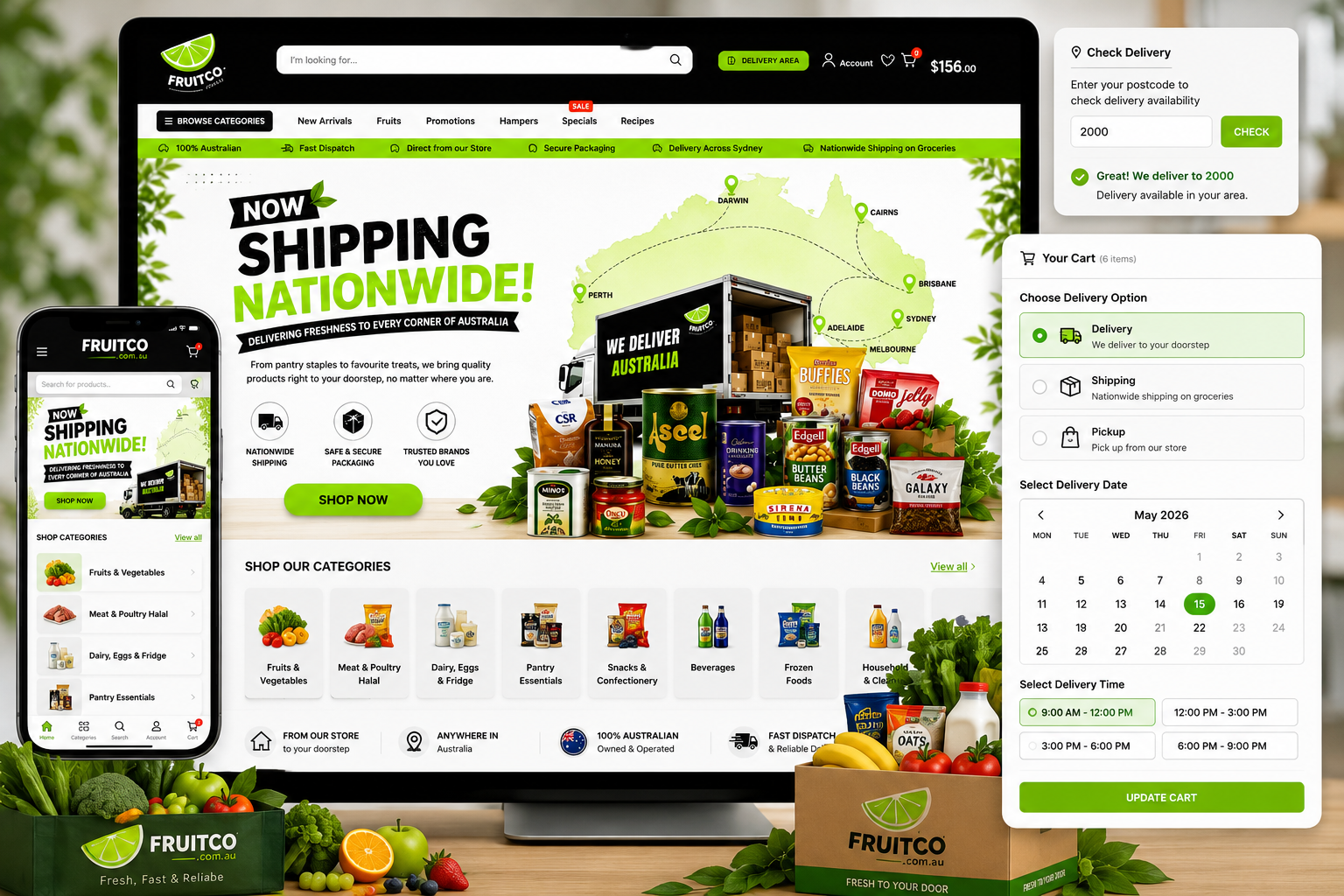
The result is a large-scale online grocery storefront covering fresh fruit and vegetables, halal meat, dairy, bakery, pantry goods, drinks, frozen products, household essentials and more. The live store also allows customers to check Sydney delivery availability using their postcode.
The challenge
The main challenge was not simply presenting a large product catalogue. It was connecting Shopify to the way FruitCo actually prepares, routes and delivers orders.
The store needed to determine:
- Whether a customer qualified for local delivery.
- Which fulfilment methods were available for the products in the cart.
- The required minimum order for a delivery area.
- Which dates and time windows could be selected.
- Whether every product was eligible for shipping.
- How fulfilment details should appear inside the final Shopify order.
These decisions had to happen before checkout while remaining understandable to the customer.
What we built
Postcode-based delivery validation
Customers can enter their postcode to check whether FruitCo delivers to their area. The postcode is then used to apply the relevant delivery rules and guide the rest of the shopping experience.
Delivery, shipping and pickup workflows
A custom cart experience separates the available fulfilment methods instead of forcing every order through the same process.
Each option displays its own instructions, required information and validation rules.
Delivery date and time selection
Eligible customers can choose a delivery date and available time window directly from the cart.
Unavailable dates, including restricted delivery days, are disabled so customers cannot select an option the operations team cannot fulfil.
Location-specific order requirements
Different postcode areas can carry different minimum-order values, delivery fees and free-delivery thresholds.
The cart checks these requirements dynamically and tells the customer what is needed before checkout.
Product-level shipping controls
The shipping workflow examines the products inside the cart and prevents incompatible items from being submitted for standard parcel delivery.
This is particularly important for separating locally delivered fresh goods from products that can travel through conventional shipping networks.
Order data automation
The selected fulfilment method, postcode, delivery date, day, time and customer details are passed into Shopify as structured order information.
This gives the operations team the information they need without manually reviewing customer messages or following up after purchase.
Dynamic cart messaging
Cart notices and progress indicators change as products are added or removed. Customers can see whether they have met the relevant minimum or how much remains before they qualify.
High-volume catalogue organisation
The storefront was structured to help customers move through a broad grocery catalogue containing fresh food, pantry essentials, drinks, frozen items and household products without losing the convenience of quick online ordering.
Technical approach
The solution was developed through custom Shopify Liquid, JavaScript, cart APIs, theme components and Shopify automation.
Much of the operational logic runs dynamically inside the cart. When a customer changes the postcode, fulfilment method, product quantity or delivery date, the interface recalculates the available options without forcing the shopper to restart the order.
Cart attributes and order notes preserve the selected fulfilment information through checkout, while Shopify Flow supports internal tagging and downstream order handling.
The implementation was built around FruitCo’s actual delivery process rather than adding a collection of disconnected third-party apps.
The difficult part of the build
A grocery cart can contain products with very different fulfilment requirements.
One basket may include fresh fruit, frozen products, household supplies and shelf-stable groceries. The system has to decide what can be delivered locally, what may be shipped and what the customer must remove or change before proceeding.
Making those rules accurate was only part of the work. The bigger challenge was presenting them without turning checkout into a long form or a confusing series of error messages.
Outcome
FruitCo now has an ecommerce platform that behaves more like an operational ordering system than a standard online shop.
Customers receive clearer delivery choices before checkout. The fulfilment team receives structured order information. Postcode, scheduling and product restrictions are handled automatically rather than through manual customer-service checks.
The result is a smoother buying experience supported by stronger control over how each order is accepted and fulfilled.
More Projects